Introduction
What in the World is Going On?
Something is not quite right…
and the deeper you look,
the harder it is to ignore.

Across the Western world, a growing number of people share the same uneasy question: What in the world is going on? Something has shifted. The rules feel different. Institutions once considered steady now behave unpredictably. And beneath the surface, many sense that the change is neither accidental nor benign.
The question itself reveals more than simple curiosity. It carries a growing sense of bewilderment. In newspaper headlines, social media feeds, and workplace policies, the same pattern keeps emerging: something is not quite right. Healthcare institutions make decisions based not on medical science but ideology. Policing resources appear increasingly focused on opinions posted online rather than the pursuit of genuine crime.
On one hand we shake our heads in disbelief. On the other, it feels like the steady erosion of common sense, with something more deliberate lurking beneath the surface.
“We feel it before we can explain it.
Something has shifted”.
As we reflect on this, many of us recognise a common thread behind the Orwellian shift in society: new agendas driven by emerging ideologies. These challenge previously held views, yet governing elites assure us that these new values will serve us better.
My journey of discovery on this matter has unfolded over the past two decades. The term “political correctness” came to the fore in the United States in the late nineteen eighties. It described the avoidance of language or actions that might offend marginalised groups. Western societies were largely sceptical about whether this healed divisions or merely deepened them. Political correctness therefore remained a fringe concept and the object of frequent ridicule.
In the past two decades, however, ideology driven by small advocacy groups has moved decisively into mainstream politics. Its march has swept through sector after sector, toppling education, healthcare, the judiciary, and more. The shift did not remain confined to the public sphere. It spread into the workplace, aided by corporations with dedicated HR departments. Not only workplace practices but even products themselves came to be labelled right or wrong.
In the early 2020s our family moved into a new house. Not only were we settling into a new location, but with the children now beyond their toddler years, it finally felt safe to invest in new furniture, confident that sticky fingers and toddler induced wear and tear were behind us. One item high on our wish list was a new kitchen waste bin.
Because it would sit in full view, we narrowed our search to something suitably stylish, eventually landing on a model with pleasing 1950s retro overtones. It had a high gloss white finish to match the work surfaces, and its dimensions were perfect for nestling beside the fridge freezer. It was not electrically powered. You open the lid, put the waste in, close the lid. Simple enough.
But what truly caught my eye was the retailer’s proud value proposition: the bin “met the strictest requirements for social justice.” This claim appeared in large, bold font beside the click to buy button. To the retailer, this was clearly a very big deal.
Now, I do not know about you, but to this day I still struggle to work out what that really means. When I think of social justice, I think of courtrooms, legal cases, and victims who have suffered under systems rigged against them. Furthermore, the phrase “strict requirements” suggests an all out resolve to correct something fundamentally wrong. What, exactly, was wrong with the bin, I wondered?
Was the bin manufacturing industry riddled with criminal gangs from the underworld? Had the aesthetic design been officially cleared as trigger free for particular groups? Had its shiny surface been rigorously engineered to ensure it was completely free from any trace of cultural appropriation?
The point is that few sectors of our lives now escape the reach of these ideologies. Products are judged as aligned or not, right or wrong. Unsuspecting customers risk being subtly re educated the moment they enter the marketplace. Commercials no longer simply promote sofas or frozen convenience food; they also signal what we are meant to believe constitutes a modern family. A simple transaction — I give you money, you give me a product or service — can no longer always be assumed.
Admittedly, we should avoid products that have caused ecological damage or undue stress to those involved in their manufacture. These are timeless principles rooted in our Christian heritage, even if their application has at times been slow or uneven. Yet linking “justice” to a kitchen waste bin felt less like ethics and more like a calculated attempt to advance the retailer’s ideological perspective, for which they are already well known. In the end, I bought the exact same bin elsewhere. The bin looks great, by the way. No regrets.
I can handle virtue signalling bins. I can roll my eyes, shake my head, take my money, and buy elsewhere. But when ideologies seep into the institutions that are foundational to how we live our lives, I am troubled.
The greatest pain I have experienced in the last decade, and I do not use the word lightly, is witnessing the corruption of the Christian Church. For decades I recognised that many large, centuries old church institutions had lost their original fervour and become susceptible to doctrinal vagueness, often compromising to win favour from those outside. What took me by surprise, however, was the seepage of woke agendas into churches and organisations that had only recently been firmly Bible believing.
A prominent example is a British charity that “helps churches to bring hope and a future to struggling children.” I had been sponsoring them through a monthly direct debit, initially glad to support their work through after school clubs and similar initiatives. In October 2020 I skim read a newsletter themed around Black History Month. The framing drew heavily on cultural Marxist thinking and included what it described as an “urgent need to decolonise the education system.”
Ten black figures were presented as aspirational role models who should be universally promoted, one of whom was Malcolm X, whom I would regard as an anti-role model for anyone with even a mild affiliation to Christianity. Thinking this might have been a rogue newsletter, I immediately emailed them. An email exchange and follow up call with a director confirmed my worst fears. This was no rogue communication; it was official policy. My subscription was cancelled immediately.
Maybe you have not spent much time in church circles, but the point remains: even institutions once considered safe from corruption have become compromised. No doubt you have your own examples of organisations that have quietly realigned themselves with new agendas.
For most of my life I have worked in the high value industrial engineering sector. This field prizes precision, reliability, rigorous design, optimised manufacturing processes, and a strong commitment to putting the customer first. I like to think that smaller enterprises still hold fast to these values. But many larger corporations, typically stock listed businesses, whether under pressure from London or New York pension investors or their zealous HR departments, have added new layers of corporate virtue.
In my hometown, a long-established stock listed enterprise now flies a large transgender flag outside one of its main buildings, not just for June but all year round. Its website even features a photoshoot of the company’s diversity officer playfully wrapped in the same flag. These signals do not produce better engineered products, although no doubt their diversity champions can offer a confident explanation for why they supposedly do. Nor, I suspect, is being evangelistically pro LGBT remotely demanded by their customers. I would wager those customers are still making buying decisions based on the old fashioned principles of value, performance, and reliability. How very un woke of them.
It is as if a new world is being constructed, driven by the pursuit of an alternative reality, even when that reality produces no measurable benefit under objective scrutiny. Nomological frameworks provide one way to test this. They are essentially maps showing how key principles within a field connect, commonly used in psychology, sociology, and economics to test whether theories hold together against real world data.
When applied to the new realities now being constructed, these tools reveal multiple weaknesses. The push for diversity, rather than easing tensions, often appears to intensify them. The ever-expanding welfare state does not realistically eliminate poverty but instead risks creating generational dependency that keeps families trapped. Whether your concern is the preservation of Western heritage or, more pragmatically, the pursuit of better outcomes for yourself and society, the evidence increasingly suggests that the current experiment is failing on multiple levels.
Many are concerned about this downward spiral. Observations abound, but what is lacking is genuine root cause analysis. Symptoms are widely debated, but if we truly want to understand, we must dig deeper.
To borrow an analogy from the world of IT, if we are to understand our culture, we must move beyond the polished user interface of modern ideas and examine their machine code, the hidden instruction set that actually drives behaviour. It is not enough to look at the screen. We must examine the code underneath.
“To understand our culture,
we must move beyond the surface
and examine the code beneath”
Section II of this book explores how the West was founded on Christian principles and how these are now being pulled apart and discredited. Historian Tom Holland writes in Dominion that to live in a Western country such as Britain is “to live in a society still saturated by Christian concepts and assumptions.” Once we understand what foundation is being attacked, and why, we can begin to answer the question, “What in the world is going on?”
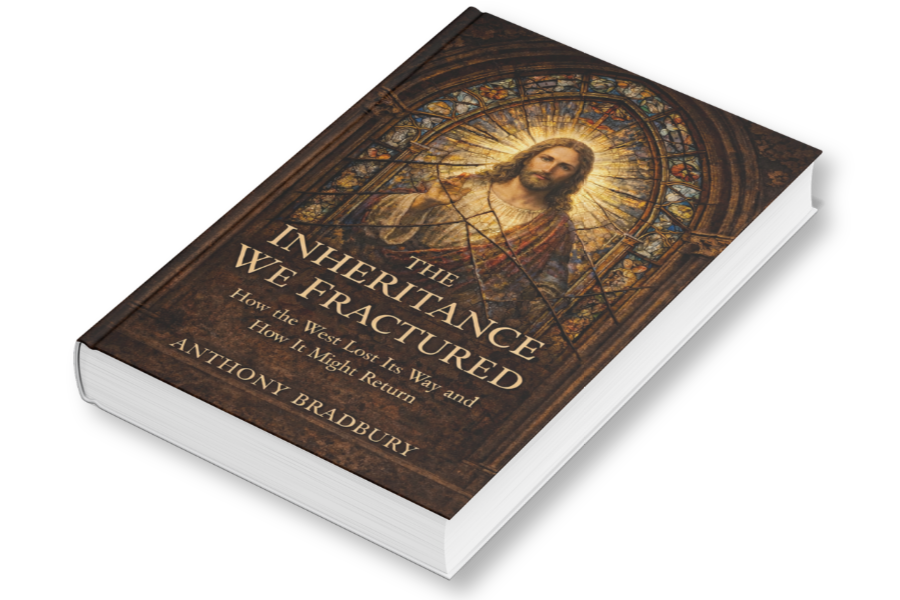
The purpose of this book is therefore twofold: to take you on a quest to uncover the truth and recognise how it is being fractured, and from there, how you might choose to respond.
This book is written on the assumption that God is real. That is not a great stretch for most people. What may be more challenging is that we will frequently quote Judeo Christian Scripture. Why?
First, if we are to understand how the West was formed, we must highlight these foundational principles, explain how they became embedded in our societies, and detail the mechanisms by which they are being attacked. Without reference to Scripture, we only scratch the surface. Many books already offer surface level analysis. They observe the outputs on the screen but fail to understand the code behind them.
Second, I know of no other source that so precisely enables the deciphering of these cultural codes. Its sixty-six books, written over millennia by forty authors, present a uniquely interlinked message that remains timeless in its application.
They contain prophecies written decades, hundreds, or even thousands of years in advance, later fulfilled as empires rose and fell or in the life of Jesus Christ, foretelling minutia of detail surrounding His birth, His mission, and His death and resurrection. To predict events in such detail across multiple unconnected authors writing in different eras is mathematically impossible.
Our interest, however, is not to prove the supernatural nature of these prophecies, but to identify the repeating code breaking patterns embedded within them so we can better understand what is happening and how to address it in any era. These Scriptures function like mathematical operators, helping us uncover the mechanisms behind today’s cultural enigma machine.
The Christian perspective is that these operators were placed there supernaturally by the Creator God, outside our time domain, to help us navigate the times in which we live. He declares, “I am the Alpha and the Omega, the Beginning and the End” (Rev 22:13), and, “I make known the end from the beginning, from ancient times, what is still to come” (Isa 46:10). There is nothing happening today that has not already been decoded for our benefit. For those willing to listen, the upper hand is available.
Before we embark on our mission to decipher today’s codes, we briefly consider an ancient narrative that sharply captures the challenge the West now faces. Around 1400 BC, the nation of Israel, still in embryonic form, had spent forty years in the wilderness and was about to enter its promised homeland. Moses was handing leadership to Joshua. His task had not been easy.
The journey from Egypt to Canaan should have taken eleven days, but because of the people’s persistent misgivings, it stretched to forty years. It was a time of preparation and nation formation. The ultimate divine purpose, however, was not merely the design of a national constitution but the shaping of a people whose hearts were loyal to Him. The results were mixed. The people complained, clung to pagan practices, and often walked in unbelief despite the multitude of miracles they witnessed.
At the handover, Moses reflects on their predicament. Deuteronomy 32 records his plea to “remember the days of old; consider the years of many generations.” He traces God’s favour upon them — how they were found in the wilderness, cared for, instructed, and later flourished and that there was “no foreign god” among them.
Then came corruption, the adoption of new ideas brought about by manmade gods, and they forgot the God who had fathered them. From strength came decay and futility. Moses declared, “their vine is of the vine of Sodom,” meaning their values had become those of cultural Sodom: material prosperity and licentiousness.
Moses laments:
28 “For they are a nation void of counsel,
Nor is there any understanding in them.
29 Oh, that they were wise, that they understood this,
That they would consider their latter end!”
This lament is echoed today by those who see the bigger picture and recognise that our current direction is not good. Yet in Scripture there is always a choice, a way out. To get there, we must heed Moses’ encouragement:
“Give hear, O heavens, and I will speak;
And hear, O earth, the words of my mouth.
2 Let my teaching drop as the rain,
My speech distill as the dew,
As raindrops on the tender herb,
And as showers on the grass.”
To solve seemingly unfathomable mysteries, we must first accept the invitation to truly hear, not merely with our ears, but with the attentive wisdom Moses longed to see in his people. Only those who listen deeply will recognise the fracture lines of our age and the path back to what is true.
My hope is that this book will sharpen your discernment, strengthen your confidence in what is true, and equip you to see beyond the surface of our cultural moment. If, by the final page, you can recognise the patterns at work around you and step forward with renewed clarity, courage, and purpose, then this journey will have done its work.
If you can recognise the patterns at work around you…
and step forward with clarity,
courage and purpose….
…then this journey will have done its work.
If this resonates, there is more to uncover.